Five Stages of the Creative Process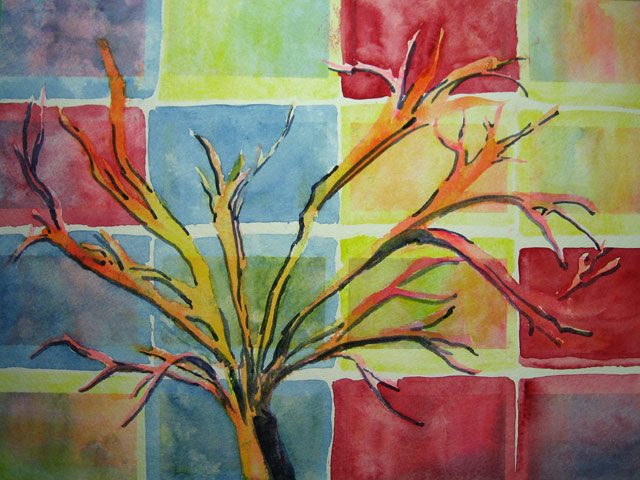
I first came across this theory of creative thinking years ago in freshman psychology. At the time I thought, this is interesting and it will probably be useful to me, in the long run.
And yes, I really have referred to it many times since.
According to this theory, the process of creative thinking separates into five general steps, which can flare into action quickly, or which can take place over a long period of time, depending on the project being considered. These steps are:
1. Identification: You identify a problem to be solved. In order for a creative solution to arise, there needs to be a situation that you know needs to be fixed. This problem could be the need to paint a landscape or to write a poem, or the need to find a way to tie a dog onto a broken leash at the park, fast! Creative thinking won't happen unless you identify a problem that needs solving.
2. Preparation: You look for ways to solve the problem that you have identified. You could research how other people paint landscapes, you could sketch out some rhymes for a sonnet, or you could rack your brain to remember your old Scout methods of tying knots. You think and compare possible ways to do what you want to do.
3. Incubation: You let things settle for a little while, so your unconscious mind can mull over the problem and the possible solutions you have thought up. Incubation could be a very quick process, or it could take a while for a solution to emerge.
4. Breakthrough: You get a great idea! A solution becomes apparent. It may feel like sudden inspiration, but this breakthrough is really the result of having applied the previous three stages of creative thinking.
5. Resolution: You try out your solution and see how well it works to solve the problem.
As an example of how the process of creative thinking works, these are the stages I followed in developing today's AEDM challenge painting:
1. I identified the problem as being me needing to complete a painting based on a 16 block arrangement.
2. Since the beginning of this month, I have been preparing ideas that I could use for daily paintings. What I did differently today was to block out divisions on the paper using masking tape. Then I painted loosely over the whole sheet and pulled away the tape, leaving a grid of plain unpainted paper to work on next. I looked at what I could do with it, and came away with no real sense of a direction to follow with the painting.
3. I decided to put the brushes down and go do something else. I came back to the work table a couple of times, but I couldn't get any clear sense of what to do next.
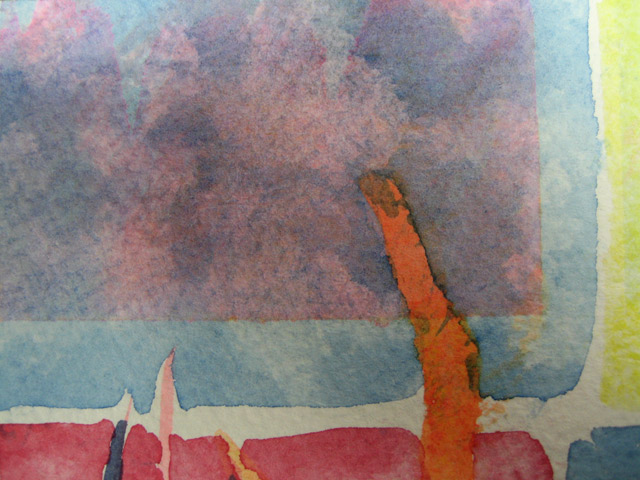
4. I was holding a paper towel in my hand when I thought of painting layers of color and blotting the wet paint away leaving textures in the paint.
5. I got back to my work table and started applying wet paint and blotting it off to leave textures. It worked the way I wanted in some places, but not in others.
In the end, I finished the painting by a steady re-iteration of these five steps... I'm not totally happy with it, but this painting has paved the way for me to try some new techniques.
 Elizabeth's Walk - Climbing - Final Layout
 Elizabeth's Walk - Climbing