Commitment: the state of being emotionally impelled to do something. My commitment is to making art, loving life and doing well.

Daily Artworks... my continuing challenge for 2015: Observe and record. Record and observe. And stretch - s-t-r-e-t-c-h - myself.
What will I discover?

Monday, November 30, 2009

Art Every Day Month - November 30

Fronds and Leaves


My last entry for AEDM for this month!

Today's painting was done, like yesterday's, with a brush-on rubber resist compound to separate the figure areas from the background areas in the picture.
Where yesterday's work was very precise and provided a clear space on the paper for a contrasting color to be painted in, today's painting is loose and free-flowing.

I feel a sense of accomplishment, certainly, at completing and posting a painting each day for the month of November, and a especially a sense of gratitude for how much progress my watercolor painting has made for the sake of an hour or two of daily practice.

And it's not just my paintings that have benefited from AEDM, because at the beginning of the month I also pledged to use Twitter to publicize my posts.
From Twitter and the AEDM'ers who used it, and from the Creative Every Day website, I feel a remarkable sense of ... community... is the only way I can describe it. And that was an unexpected bonus!

Thank you everyone for a great experience working with you! I will be checking in on your websites and blogs from time to time to see how you are doing. I invite you to continue to check into mine as well.

Sunday, November 29, 2009

Art Every Day Month - November 29

A Tray of Gingerbread Cookies


All the activity at home this weekend has been baking, and baking gingerbread cookies, in particular. The whole house smells spicy and warm.

Baking, like painting, is a precise activity, with a certain tolerance for error, but with a critical eye for the characteristics and conditions of those errors.

I could beat myself up over accidental backflows in my watercolor washes, in the same way that I could reject a batch of cookies which got burned on the bottom.
I could do both those things, but right now, I won't.
I know I will become a better painter and a better baker, if I acknowledge my accidents and the mistakes that caused them, and watch next time so I don't make those mistakes.
I may make other mistakes, but, if I stay alert and remain aware of what I am doing, I will continue to improve.

And I will continue to enjoy what I am doing.
It's a bonus for me that other folks enjoy what I am doing, both paintings and cookies!

Saturday, November 28, 2009

Art Every Day Month - November 28

8 Words for the Holiday Season


A friend of mine discovered some ancient rubdown letter sheets in his basement, and passed them on to me thinking I might be able to use them.

Old English typeface in gold letters!
And just before Christmas!
Well, of course I could use them!

I didn't even have time to get my brain in gear before I started to see the Christmas words forming... and y'know once you start, it's awfully difficult to stop.

An interesting thing about the old rubdown letters is that the way in which they glue themselves to the paper makes them water resistant.
So you can paint over them with watercolor and the water will pool back from the letter onto the paper where is will be soaked up.
This can lead to some interesting markings around the edges of the type, a sort of random drop shadow effect, or the appearance of a highlight where none really exists.
And this can add visual emphasis to what could be a very ordinary application.

So, with thanks to my generous friend, scant days away from Christmas, my Advent gift to you is the meaning of these eight words in the Holiday Season.
Happy Advent!


Friday, November 27, 2009

Art Every Day Month - November 27

Signaling Flags


I am spelling the message in today's challenge using the International Code of Signals, or ship's signaling flags.

I was planning to leave the background as plain white paper, but I decided that the flags needed some visual separation, and that it would be more interesting to look at the overall design against a background, like a sky.

Sailors who know this system will realize that I have included a whimsical flag that does not have an official entry in this code, and to these folks I also acknowledge, to my chagrin, that I have hung one of the flags backwards.

To those who cannot read this message... may I suggest that you do an online search to find an alphabet of signaling flags, and then decipher the message as a puzzle.

And to all, I say, doing these AEDM paintings really does my "art" good!


Art Every Day Month - November 26

Saltscapes


In all the time I have been painting with watercolors, I have never used the technique of sprinkling salt onto wet washes to achieve that characteristic random granular texture.
So today I tried it. I painted today's challenge in three layers, lemon yellow deep, alizarin crimson and prussian blue, and each layer had to dry completely before I moved to the next. I learned several things.

1. I had to wait. And wait.
Each grain of salt (what's the technical word?) pulled the water and the paint towards it, and that's where the color stayed as the water dried, on the salt crystal or on the surrounding paper.
And it took a long time. And, I went to bed not knowing how the painting would turn out.

2. The results were random and to a large extend uncontrollable.
I could control the placement of the sprinkles, and the direction in which I laid down the salt, but after that, the water took over and it was the water that actually painted the picture.

3. The salt effect was strongest in the places where the wash was the wettest... and where there was the most paint in the wash. The least effect was in places where I graded the washes down to almost pure water.

4. It was easiest to brush the salt crystals off the paper at that point when the paper was still a little moist but the paint had dried completely.
After I had left the painting to dry overnight, I had to almost grind the salt crystals off the paper... it was like working with sandpaper.

5. If salt can be messy, this is a messy technique! I brushed away the salt from the yellow layer at my work table... and I will now have to vacuum up the residue.
For the other two layers I cleared the salt off the paper over the bathtub!
And it's not just clean salt... most of the crystals are covered in paint, and if they get wet again, even from moisture in the air, those darn crystals will continue to paint whatever they have settled upon!

5. I'm glad that it tried it, after all this AEDM is playtime with the art toys for experimentation with techniques.
I don't think this salt technique is something I will add to my repertoire. But, it might just be useful, sparingly, for special effects.
And that's always good to know.

Wednesday, November 25, 2009

Art Every Day Month - November 25

Five Stages of the Creative Process
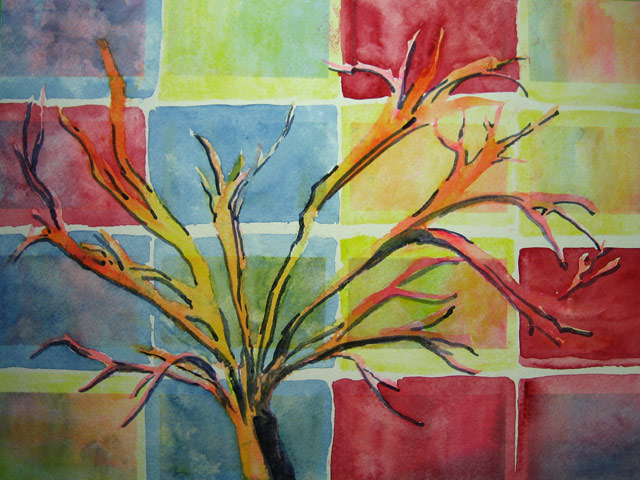


I first came across this theory of creative thinking years ago in freshman psychology. At the time I thought, this is interesting and it will probably be useful to me, in the long run.
And yes, I really have referred to it many times since.


According to this theory, the process of creative thinking separates into five general steps, which can flare into action quickly, or which can take place over a long period of time, depending on the project being considered. These steps are:


1. Identification: You identify a problem to be solved. In order for a creative solution to arise, there needs to be a situation that you know needs to be fixed. This problem could be the need to paint a landscape or to write a poem, or the need to find a way to tie a dog onto a broken leash at the park, fast! Creative thinking won't happen unless you identify a problem that needs solving.


2. Preparation: You look for ways to solve the problem that you have identified. You could research how other people paint landscapes, you could sketch out some rhymes for a sonnet, or you could rack your brain to remember your old Scout methods of tying knots. You think and compare possible ways to do what you want to do.


3. Incubation: You let things settle for a little while, so your unconscious mind can mull over the problem and the possible solutions you have thought up. Incubation could be a very quick process, or it could take a while for a solution to emerge.


4. Breakthrough: You get a great idea! A solution becomes apparent. It may feel like sudden inspiration, but this breakthrough is really the result of having applied the previous three stages of creative thinking.


5. Resolution: You try out your solution and see how well it works to solve the problem.


As an example of how the process of creative thinking works, these are the stages I followed in developing today's AEDM challenge painting:
1. I identified the problem as being me needing to complete a painting based on a 16 block arrangement.
2. Since the beginning of this month, I have been preparing ideas that I could use for daily paintings. What I did differently today was to block out divisions on the paper using masking tape. Then I painted loosely over the whole sheet and pulled away the tape, leaving a grid of plain unpainted paper to work on next. I looked at what I could do with it, and came away with no real sense of a direction to follow with the painting.
3. I decided to put the brushes down and go do something else. I came back to the work table a couple of times, but I couldn't get any clear sense of what to do next.
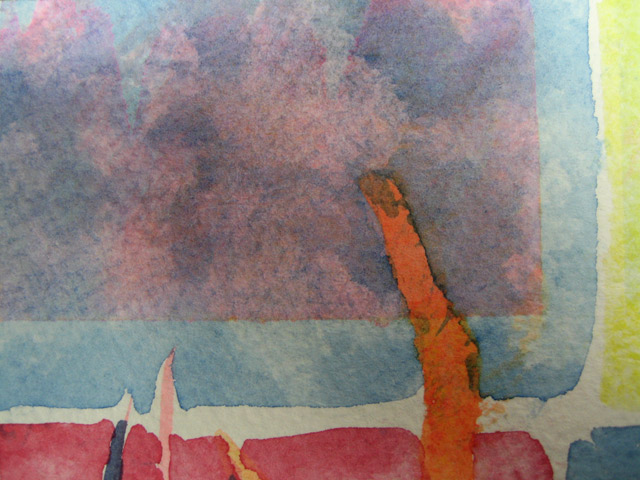
4. I was holding a paper towel in my hand when I thought of painting layers of color and blotting the wet paint away leaving textures in the paint.
5. I got back to my work table and started applying wet paint and blotting it off to leave textures. It worked the way I wanted in some places, but not in others.


In the end, I finished the painting by a steady re-iteration of these five steps... I'm not totally happy with it, but this painting has paved the way for me to try some new techniques.


Tuesday, November 24, 2009

Art Every Day Month - November 24

16 Star Blocks


Ask a quilter what a 16-patch is.
It's a patchwork quilt pattern arranged with four squares running horizontally and four squares running vertically.

The watercolors I have been doing for AEDM have the same configuration of 16 blocks, if not the same proportions.
So you know it was only a matter of time before I broke out the quilt patterns to put a 16-patch design together.

I love star quilt patterns, and I wanted to play around with emphasizing the triangles that make up the star shapes by using contrasting colors... complementary colors, actually.

I like that I have got a sparkling background with the blue and violet "Star Puzzle" blocks in the background, and the four orange and yellow "Mariner's Star" blocks in the corners twinkle nicely against it.

I regret that the four "Guiding Star" blocks in the center appear to have a rigid rectangular border. Takes away from the night sky look.

Too bad this design is a watercolor painting... a quilter could just pick out the stitches on the offending areas and patch together the right colors!

Followers

Blog Archive

.